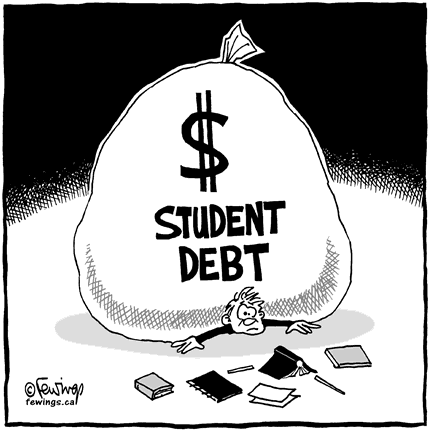
When Paul McGinnis heads back to college in Spokane today, he'll be packing more than his CDs, laptop and favorite sports posters. He's also carrying some newfound financial awareness.
Money's tight this year in the McGinnis family, and it's made the 19-year-old college sophomore think twice before whipping out his debit card for every little purchase. Earlier this year, his dad, Greg, was laid off from a 20-year job in the building materials industry and his mom, Nancy, took a pay cut from her administrative job at Kaiser.
Everyone's watching the wallet, including Paul, who will be living in a dorm at Whitworth University.
Many high school seniors faces the most challenging problem with their parents in the month of April, how to pay for college. This year college funds have been taking hits this year due to the stock markets. Parents might not have amount saved up for college tuition. Although there is a portion of the stimulus bill from the Obama Administration are aiming to give some cash to save the mess, but it takes time. Below are two tips that will help families to pay for college.
Limit your student loans, this year freshman’s are allow to borrow up to $5000, $6,500 sophomores and $7,500 for seniors this year. Although these are small loans, parents can borrow from the federal PLUS loans for the rest of the college fees. Banks also offer loans but at a higher rates and more expensive, these are mostly for families that can afford to repay in the future, or school that are worth the extra debt.
Parents can also use some home equity or their house for helping the loan. Home equity interest rates are 5.5 percent on average, but you can find rates that is as low as 3.3% when you have a good credit score or have a good amount of home equity. These loans are tends to be cheaper than other students loans. The down side to these loans is that debt might carry over into their retirement plan.
Buoyed by a run of good news in the stock market, I recently decided to check the balance in my son's 529 college savings account for the first time in many months. To my dismay, the account was still down some 40% from a year ago, far below the amount my husband and I had originally invested. Given the extent of the losses, I couldn't help but wonder: would it make sense to just ditch this thing? (Read "Investing in a 529 College Savings Plan.")
I'm sure I'm not the only one contemplating this question. Named after section 529 of the Internal Revenue Code, these plans can be a terrific tax-advantaged way to save for college, but many of these accounts have been seriously thwacked in the bear market. As of Feb. 28, half of 529 portfolios had one-year returns of -30%, and a third had returns of -40% or less, according to Morningstar, which tracks the performance of over 3,600 plan portfolios. In some cases, 529 investors may not have been well informed of the risks. On April 13, the state of Oregon sued the managers of its 529 plan, OppenheimerFunds, alleging that Oppenheimer took too much risk with its "ultra-conservative" and "conservative" portfolios, alleged mismanagement that Oregon claims resulted in a $36.2 million loss for 529 plan investors. (See how students are paying for college.)
Here’s another reminder of how the housing market collapse has spread its ugly tentacles into just about every corner of our lives.
Parents of college age children, already worried about their job security amid the recession, are also finding that the traditional piggy bank often used to pay tuition bills is just about empty, a recent New York Times article points out.Taking out a home equity line or second mortgage to help pay your kids college education is as American as apple pie.
Long before the current housing market boom my father was doing just that to help put three children through college.
But with home values having fallen off a cliff, many homeowners now find themselves underwater, with no equity at all to tap.
Banks are also balking at granting second mortgages, even when there is plenty of equity to back them up, to those with credit records that are less than perfect or whose pay is heavily reliant on commissions or bonuses, the article notes.
Colleges are now scrambling to adjust, with many, for now, having to lobby for other forms of aid for students whose parents are suddenly house poor.
Paying for college in the recession just add problems and stress for both parents and students.The final step for applying for most of the students is the financial aid. Below are some steps that will help you to the financial aid that you need.
1)Don't panic over the money - paying for college is not a cheap investment. According to the College Board number the average tuition for a four year private college is $27,561, and public is $11,354. Tuition may be as high as $40,000 for Ivy League schools. Although these prices are very high, don’t panic, according to College Board, 70% of the students pay less than $9,000 for tuition per year.
2)Fill out FAFSA - In order to begin your financial aid, you have to fill out the FAFSA, form, about two weeks later you will receive a form that will need to be fill out with the expected amount the family is willing to pay.
3)Don't give up – College is one of the best investments, and it will have its returns.
4)Grades matter – The better the grade that a student have, the more options they can choose from, and receive a scholarship or a low cost to tuition for a college.